
Silfio country intelligence · ALB
Albania
0.9% annual new-conflict probability
How to read these probabilities: Scores estimate the probability of a new armed conflict starting within the next 12 months. Ongoing conflicts can have a saturation effect, reducing the modelled probability of an additional conflict onset. A low or falling score does not imply less severe ongoing fighting or a safer country.
Population
2.35M
GDP
$30.54B
Currency
ALL
Capital
Tirana
Land area
28.75K km²
Official languages
Albanian
Risk assessment
Risk profile
The 12-month probability of a new armed-conflict onset in Albania is 0.9%, representing a minimal risk. Albania’s post-communist history includes serious political unrest, including the 1997 nationwide crisis, but the country has since developed stronger state institutions, security capacity, and European political and economic ties that generally contain domestic confrontation.
The strongest current evidence is the escalation of student-led anti-government protests in Tirana during 14–18 October 2026. Demonstrators demanding Prime Minister Edi Rama’s resignation have fought riot police, used petrol bombs, and damaged or burned offices and banks; at least 120 police officers and 32 protesters were reportedly injured. Rama’s government, the police, protesters, and the European Commission are the principal actors, with Brussels urging accountability and proportionate force.
The main uncertainty is whether the protests remain episodic urban unrest or develop into organised, sustained armed violence involving wider political or criminal networks. Risk would rise if clashes spread nationwide, security forces fragment or use lethal force, or armed groups exploit the disorder. It would fall most clearly through a negotiated political process, credible accountability for abuses, and a sustained end to violent confrontations.
Strategic reasoning
- Albania’s history of severe political disorder shows that institutional stress can produce dangerous escalation, but stronger institutions and international integration make a new nationwide armed conflict less likely than contained unrest.
- The October clashes are the clearest escalatory signal: repeated confrontations, petrol bombs, injuries, and spreading demonstrations create an avenue from protest violence toward organised domestic armed violence.
- The protests remain concentrated around political demonstrations and police responses rather than a sustained insurgency or civil war; fighting by Albanian forces abroad is not relevant to a new onset on Albanian territory.
Critical indicators
- On 18 October 2026, protesters in Tirana again clashed with riot police and threw petrol bombs during the sixth day of student-led demonstrations seeking Edi Rama’s resignation. Repeated violence around government sites raises the risk of further escalation.
- On 18 October 2026, reporting cited official figures of at least 120 police officers and 32 protesters injured over four days. The scale of injuries and allegations of police violence are intensifying mobilisation and increasing pressure on the government.
- On 18 October 2026, the European Commission condemned violence and called for accountability, lawful proportionality, and peaceful protest. External scrutiny and Albania’s EU aspirations provide incentives for de-escalation, while Rama’s refusal to resign keeps the immediate political confrontation active.
Probability trend
How the Albania estimate has moved
Probability0.9%0.9%0.9%
Sep 30
Oct 5
Oct 12
Oct 15
Oct 19
Date
Current conflicts
Source: UCDP
No active conflicts in Albania.
Regional context
Albania compared with its neighbours and region
Albania ranks number 111 of 196 in new conflict outbreak risk.
Land neighbours
Southeast Europe
Figures are each country's modelled probability of a new armed conflict on its territory within the next 12 months. Select any country to open its full profile.
Related coverage

www.aljazeera.com
Photos: Antigovernment protesters clash with police in Albania’s capital | Protests News | Al Jazeera
Read source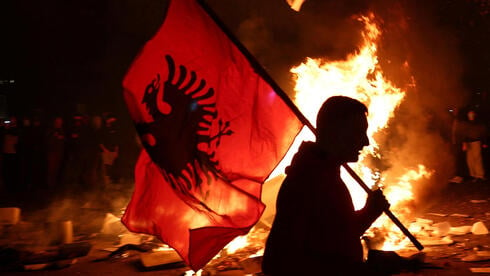
www.ynetnews.com